
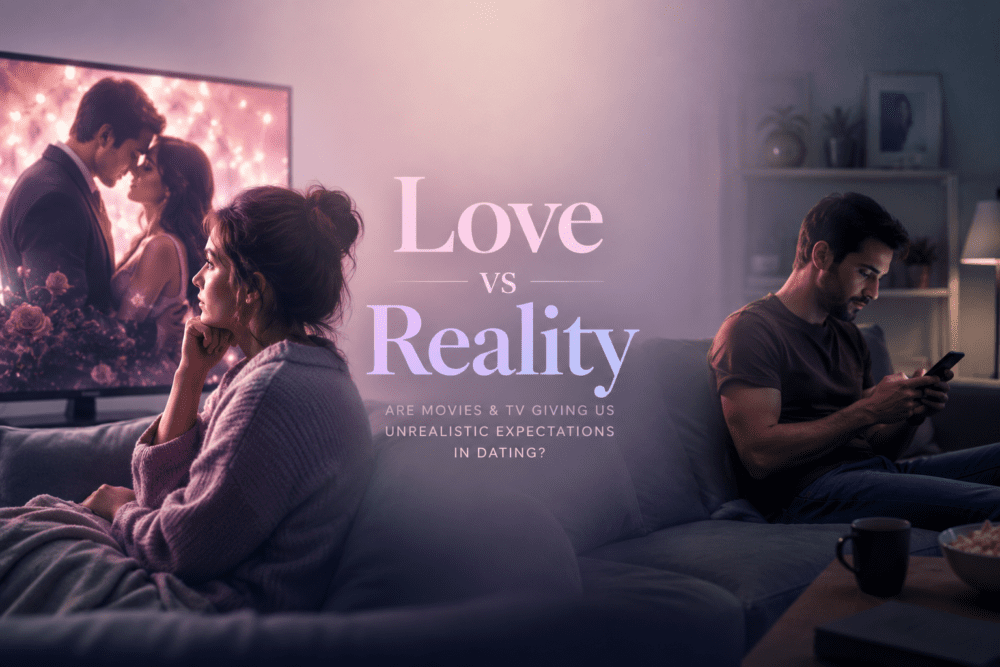
A woman watches 4 Hallmark movies in a weekend. By Monday she is annoyed that her husband of 12 years failed to surprise her with flowers or a trip to a small town where it happens to be snowing. She knows the feeling is irrational. She watches another one the following Friday anyway. A 2024 study published in Psychological Reports surveyed 279 married adults and found that more frequent Hallmark movie viewership was positively associated with endorsement of destiny beliefs, the conviction that opposite-sex friendships are inherently problematic, and the expectation that a partner should know what you need without being told. The formula works on the audience even when the audience knows it is a formula.
What Cultivation Theory Predicts
Cultivation theory, developed by George Gerbner in the 1960s, argues that repeated exposure to consistent media messages shapes a viewer’s perception of reality over time. The theory was originally applied to television violence, but researchers have since extended it to romantic content. The logic is the same. If a person watches enough stories where love arrives suddenly, fixes everything, and never requires maintenance, that person begins to treat those outcomes as plausible baselines rather than fiction.
A study from Heriot-Watt University in Edinburgh found that fans of romantic comedies like You’ve Got Mail and The Wedding Planner regularly failed to communicate with their partners, holding the view that if someone is meant for you, they should already know what you want. The researchers linked this to a pattern in romantic media where conflict is resolved through grand gestures rather than conversation.
Real Choices vs. Scripted Ones
Movies present a narrow set of relationship types. The couple meets by chance, falls in love on schedule, and ends up together by the final act. In practice, people pursue a wider range of options. Some want long-term commitment. Others prefer to date a sugar baby or keep things casual with no expectation of permanence. The screen rarely accounts for this range.
What people choose in their actual lives has little in common with what gets greenlit for a theatrical release. The mismatch is old, and the media has done almost nothing to close it.
The Age Gap on Screen vs. Off Screen
Hollywood has paired older men with younger women since the silent era. Debbie Reynolds was 19 opposite Gene Kelly at 40 in Singin’ in the Rain. Kim Novak was 25 opposite James Stewart at 50 in Vertigo. An analysis of over 880 on-screen relationships across 630 films found that the average age gap between romantic leads in Hollywood is substantially wider than the 2.2-year average among real couples in the US. The screen version of romance has always skewed older-male, younger-female, and that pattern has been absorbed by audiences for decades without much resistance.
When the gap is reversed, the older woman is often written as desperate or predatory. Recent films like Babygirl, with Nicole Kidman at 57 playing a CEO in a relationship with a younger intern, have started to challenge that framing, but they remain exceptions.
What Reality TV Adds to the Problem
The Bachelor isolates contestants in a controlled environment where emotions accelerate on a compressed timeline. Dating shows like Love Island reward dramatic behavior because it attracts viewers. Neither show resembles how people actually meet, evaluate, or commit to a partner. The format creates a version of dating where decisions are made in weeks, compatibility is tested through group conflict, and the audience treats the outcome as a referendum on the reality of love itself.
A person who watches these shows regularly absorbs a set of norms that do not apply outside the production. The expectation that attraction should be immediate, that chemistry should be obvious to a room full of strangers, and that hesitation is a red flag all come from a format designed to generate content, not relationships.
The YouGov Numbers
A YouGov survey found that 54% of Americans consider the way romantic films portray love to be very or somewhat unrealistic. Among those who held that view, 51% said the portrayals lead people to have unrealistic standards for their own relationships. The numbers suggest that most people are aware of the distortion but still absorb it. Knowing a thing is unrealistic and being unaffected by it are not the same.
What the Research Says People Actually Want
Studies on long-term relationship satisfaction consistently rank communication, conflict resolution, and financial alignment above passion, surprise, and spontaneity. Gottman’s research found that couples who maintain a ratio of 5 positive interactions to every 1 negative interaction during conflict are far more likely to stay together. The traits that keep couples together over 10 or 20 years are rarely the ones that make it into a screenplay. A couple arguing productively about the grocery budget does not sell tickets. A man running through an airport does.
The gap between what people are conditioned to want and what actually predicts satisfaction is where most of the damage sits. A person who expects their partner to read their mind, based on years of watching characters do exactly that, is less likely to say what they need out loud. A person who expects the early intensity of a relationship to last indefinitely, based on films that end before the intensity fades, is more likely to interpret normal cooling as failure.
The Correction That Has Not Arrived
Some newer films and series have attempted to show relationships with more friction and ambiguity. But the dominant format remains intact. The couple meets, the tension builds, the resolution arrives, and the credits roll before anything difficult happens. The audience leaves with a version of love that has been edited, scored, and lit to look better than anything a real Tuesday evening can deliver. The conditioning is a byproduct of what sells. And what sells has not changed enough to stop shaping what people expect when they sit across from another person and try to figure out if this is going anywhere.
