
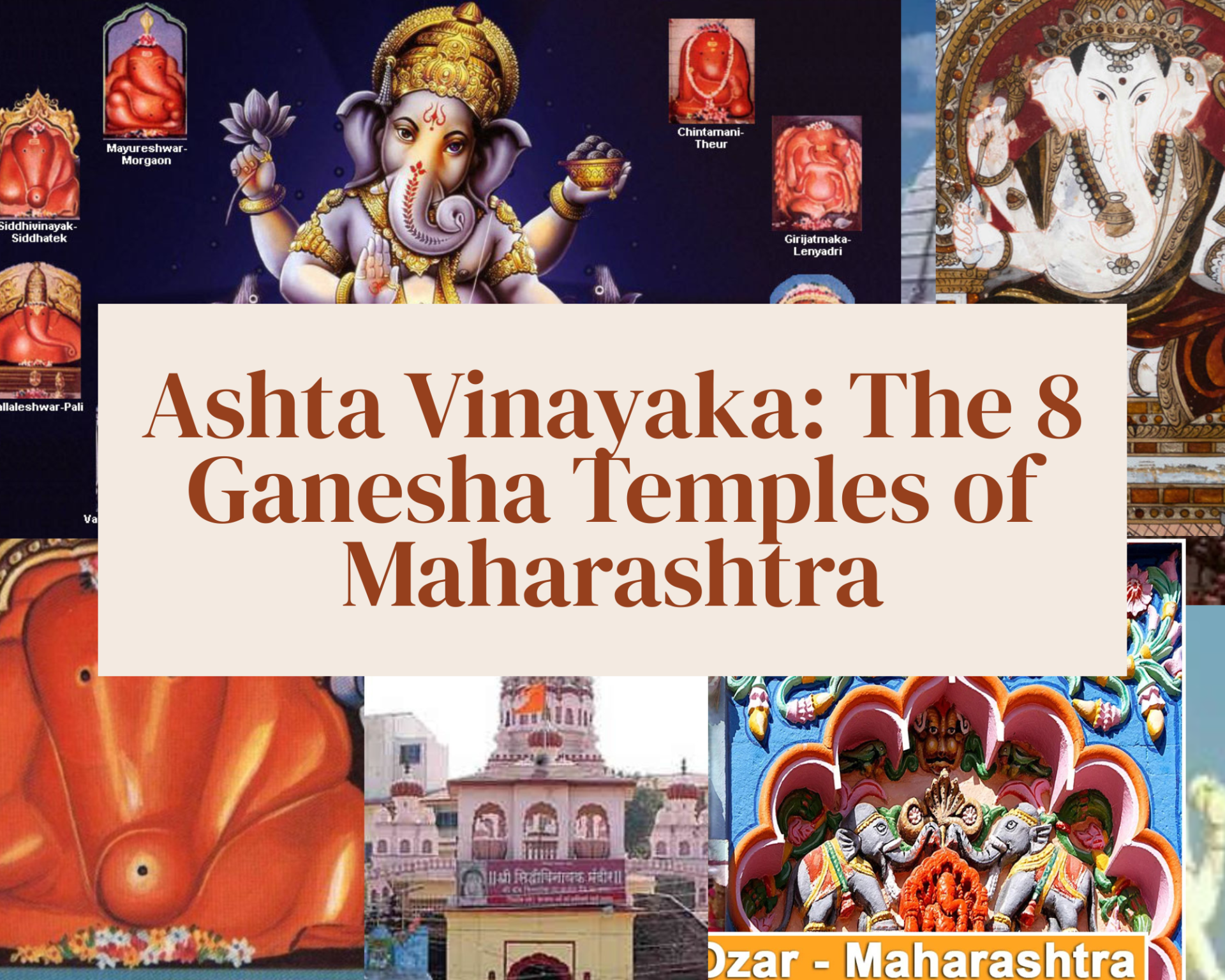
The Ashta Vinayaka pilgrimage is one of the most sacred pilgrimages in Maharashtra, which comprises of 8 Swayambhu (self-manifested) temples related to Lord Ganesha. It is believed that if we complete the Ashta Vinayaka yatra in traditional order, we will obtain great peace, wisdom and success without any obstacles in life.
Table of Contents:
- About Lord Ganesha
- What is Ashta Vinayaka?
- Here are the Ashta Vinayaka Temples in Maharashtra of Lord Ganesha
- 1. Shri Mayureshwar, Morgaon
- 2. Shri Siddhivinayak, Siddhatek
- 3. Shri Ballaleshwar, Pali
- 4. Shri Varadvinayak, Mahad
- 5. Shri Chintamani, Theur
- 6. Shri Girijatmaj, Lenyadri
- 7. Shri Vighneshwar, Ozar
- 8. Shri Mahaganapati, Ranjangaon
- F.A.Q.s
- Conclusion
Who is Lord Ganesha?
Lord Ganesha is the son of Lord Shiva and Parvati and the brother of Lord Kartikeya, who is the protagonist of this pilgrimage. S. One opinion says that Ganesha is unmarried and is a Brahmachari. But two Puranas speak about the marital life of Lord Ganesha, while Mudgala and Shiva Purana are regarded as experts on Lord Ganesha’s marital status. In the Shiva Purana, Lord Ganesha’s two sons are known as Shiva’s Shubh and Labh. Shubh and Labh are personifications of auspiciousness and profit. Shubh was the son of Goddess Riddhi, while Labh was the son of Goddess Siddhi.
What is Ashta Vinayaka :
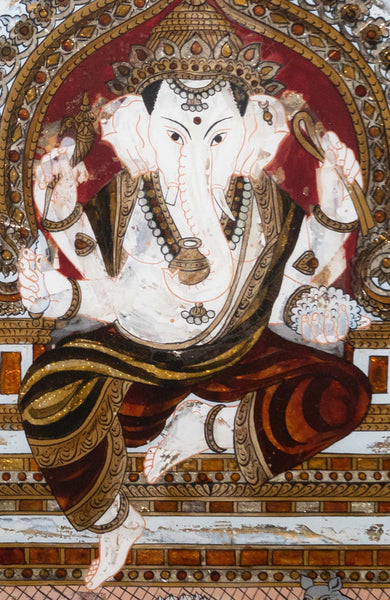
Ashta Vinayaka means “Eight Vinayakas” and Vinayaka is one of the oldest and strongest names of Lord Ganesha, which means “the supreme remover of obstacles” or “the leader with no master.” It is an official name given to a pilgrimage route of eight temples of Ganesha which are declared as self-manifested (swayambhu) and concentrated around Pune in Maharashtra, India.
The Ashta Vinayaka can be best interpreted as a sacred yantra that was engraved on the land. They are not a random selection; they are a cluster, a scattering, of one body, one mind, one consciousness vibrating with each different aspect of Ganesha’s divine power: Ballaleshwar, the tender child; Mahaganapati, the cosmic sovereign; Girijatmaj, the ascetic in the cave; Chintamani, the anxiety-dispelling physician.
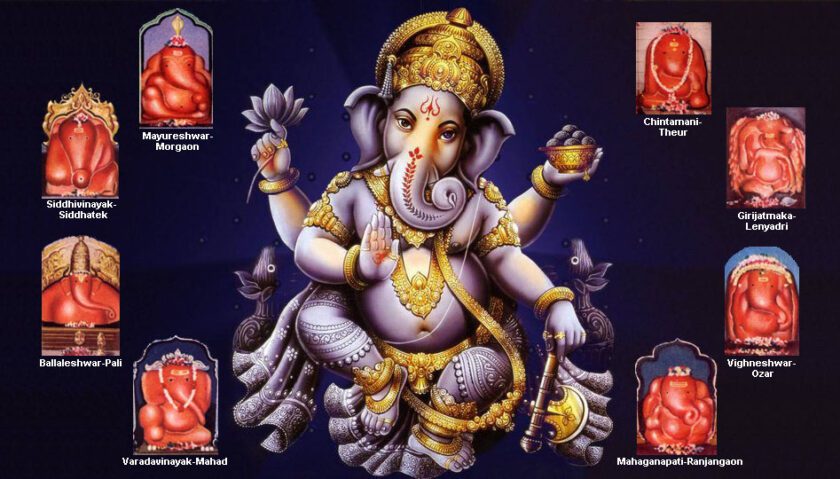
Here are the Ashta Vinayaka Temples in Maharashtra of Lord Ganesha:
Maharashtra’s Ashta Vinayaka yatra is almost always reduced to a checklist—eight temples, a convenient road trip, a perfunctory fulfilment of a vow. Yet to the discerning pilgrim, these eight self-manifested forms of Lord Ganesha constitute nothing less than a ritual mandala inscribed upon the Deccan plateau, an embodied treatise on the metaphysics of obstacle removal. They are not merely shrines; they are eight archetypal frequencies of the single elephant-headed consciousness, each vibrating with a distinct rasa, a specific tantric purpose, and an unrepeatable dialogue between stone and spirit.
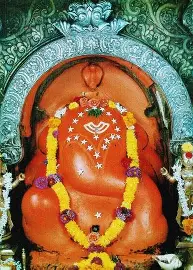
1. Shri Mayureshwar, Morgaon
District: Pune
The eight are the most architecturally commanding of which Morgaon is the first. Most temples portray Ganesha as a junior deity before Shiva in a subservient position, but here there is a large Nandi right before the main entrance facing his Lord’s son – a tender acknowledgment by the Shaivites that the elephant-god in this period is the family’s deity. Mayureshwar’s murti is a white-limestone figure with three eyes and the trunk facing to the left. It’s adorned with a snake as its rosary or sacred cord – a naga-bandha – which is a reminder to the knowledgeable eye that Kundalini symbolism is never far from Ganapatya mythology.
Here Ganesha on a peacock killed the demon Sindhu who had been granted the ability to be invulnerable and who had terrorized the three worlds. The allegory is bright: the peacock is the vehicle of God of war Kartikeya who gave his mount to his brother. The story therefore represents the assimilation of martial energy (Kartikeya) into the constructive, learning-centered Ganesha principle.
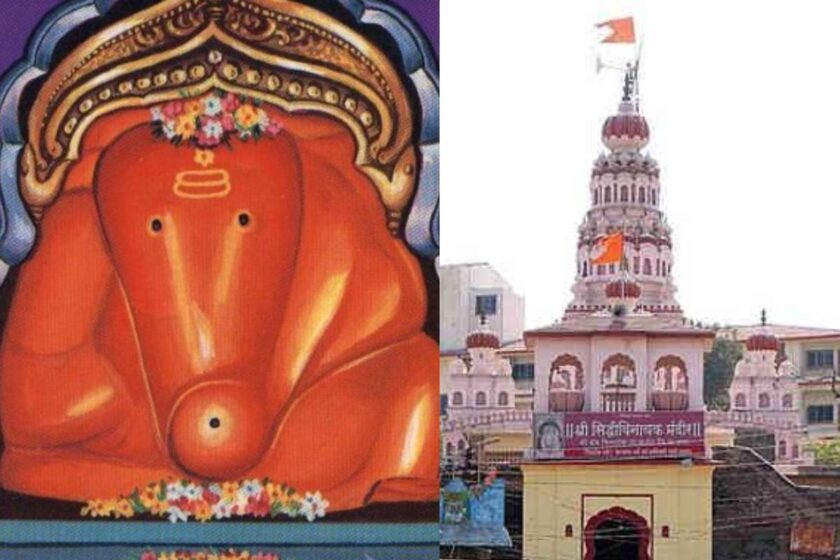
2. Shri Siddhivinayak, Siddhatek
District: Ahmednagar
Power is the axis of Siddhatek. The murti here is dakshinabhimukhi; that is, the trunk is bent to the right, a rarity and such a powerful, sacred form that few people would find it appropriate for everyday use at home. It is a form that requires the utmost ritual purity and concentration. The temple is on a small hillock next to the river Bhima, and, in the monsoon season, this area becomes an island, representing the metaphor of the boat of the shrine holding its place in the ocean of life.
As is well known to everyone, Vishnu appeased Ganesha here prior to killing the demons Madhu and Kaitabha. Siddhatek is thus a non-golden temple. It is the shrine of nirbija samadhi, which means the state achieved when the residual seed is gone. The right-turned trunk brings the Ida nadi, lunar, cooling, channel, into solar (outwards) movement of a siddhi which needs to be dealt with carefully. This is a sense of density, a pressing down of the air here – a sense of capacities about to be given.
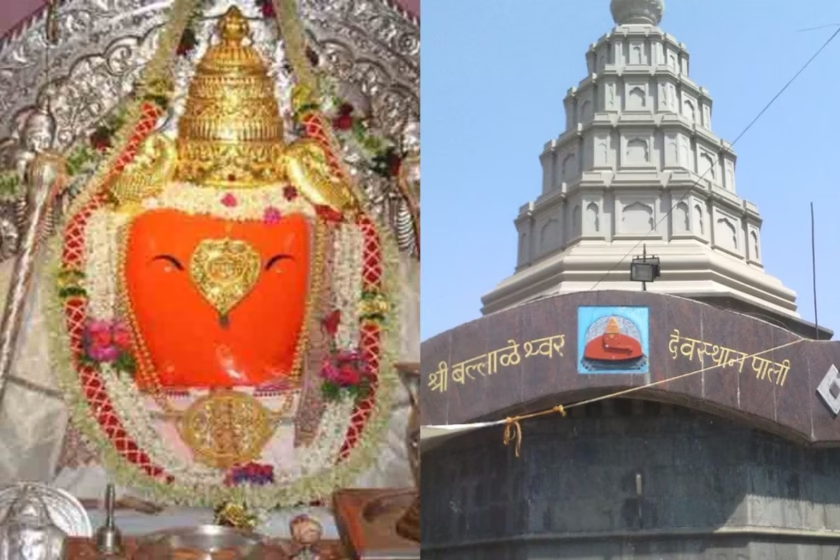
3. Shri Ballaleshwar, Pali
District: Raigad
River: Amba
Pali offers the most tender bhakti-rasa. The Ganesha here is known by the name of his devotee, Ballal, a boy whose unshakeable concentration on the Lord enraged his worldly father. The father beat the boy, tied him to a tree, and destroyed his clay murti. Ganesha manifested in the form of a Brahmin, healed the child’s wounds, and took up permanent abode in a massive stone form—the very image we see today, with its eyes bowed softly in vatsalya (parental affection).
This is the only shrine where the murti is adorned with a wooden sabhamandapa (hall) constructed by Nana Phadnavis, who blended Maratha craftsmanship with Peshwa-era opulence. The deity’s sweet-meat offering is not the standard ukadiche modak but a unique cardamom-infused, flat, roasted preparation called besan ladoo. Crucially, the murti faces the west—a direction associated with the setting sun, the dissolution of worldly ties, and the realm of the ancestors. Pali thus teaches that true devotion dissolves lineage-bound karmic patterns, as Ballal’s devotion dissolved the rigidity of his father.
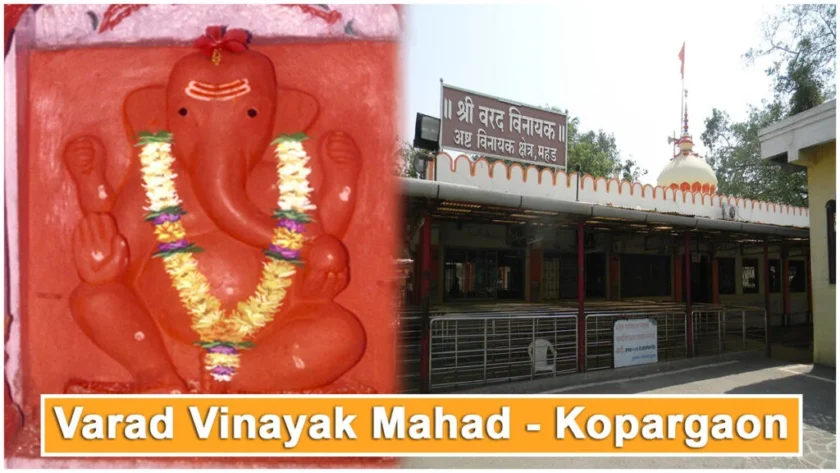
4. Shri Varadvinayak, Mahad —
District: Raigad
River: Varadvinayak stream
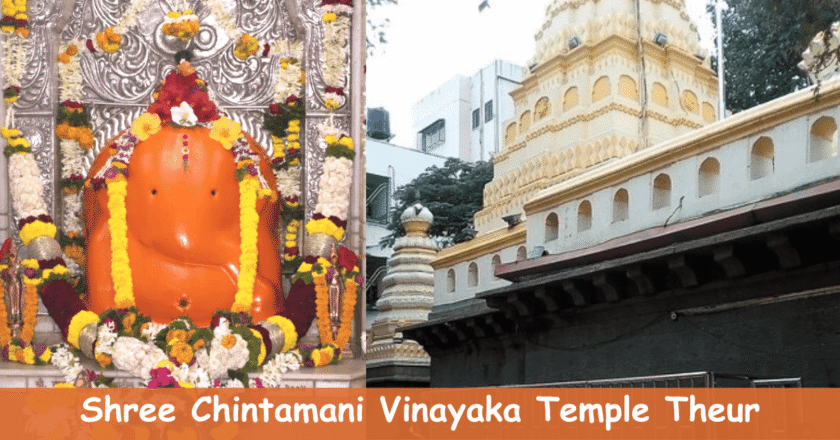
5. Shri Chintamani, Theur — The Extinguisher of Anxiety
District: Pune
Rivers: Mula-Mutha confluence
Chinta is not mere worry; it is the debilitating, circular mental rumination that keeps the self trapped in a cage of its own making. Theur, the site where Ganesha retrieved the wish-fulfilling Chintamani jewel from the greedy sage Kapila, is the laboratory for dismantling this mental affliction. The murti here is a large, left-turned, seated figure, its belly uniquely covered with a silver shield—a gesture that guards the cosmic secrets it holds.
The sage Kapila lost his jewel to the king Abhijit. Ganesha, as Chintamani, battles the forces of rajas and restores the jewel. The esoteric teaching is stark: the jewel of inner contentment is never stolen by external circumstances; we ourselves project it outward and then lament its loss. Chintamani Ganesha internalises the jewel, wearing it around his own neck, indicating that the only true chintamani is the stilled, luminous Atman. A deep surrender here, meditating upon the deity’s dark, unblinking eyes, can dissolve anxieties whose roots are far older than this lifetime.
6. Shri Girijatmaj, Lenyadri — The Cave-Born Son of the Mountain
District: Pune
Environs: Buddhist Caves complex
Lenyadri is the most archaeologically startling of the Ashta Vinayaka shrines. The temple occupies what was originally a first-century Hinayana Buddhist vihara (Cave 7). In the early medieval period, the cave was re-sacralised, and a large, rough-hewn Ganesha emerged from the living rock of the rear wall. Girijatmaj, the son of Girija (Parvati), an image of the divine child nestled not in a man-made garbhagriha but in the very stone belly of the mountain-mother.
This temple is the penultimate stop for a reason: the climb of 307 steps is not just physical exertion but a psychic ascent. The murti is unpainted, left in its raw basaltic grey, forcing the pilgrim to engage with the unadorned tattva (elemental principle). The Buddhist vihara context invites an advanced contemplation: Ganesha is the guardian of thresholds, and here, he guards the threshold between the meditative stillness of the Sramana tradition and the devotional dynamism of the Puranic tradition, showing them not as rivals but as a seamless continuum. To sit in this cave with eyes adjusted to the dark is to feel the pulse of Om in the stone before the stone was even given a name.
7. Shri Vighneshwar, Ozar — The Lord Who Holds Up Obstacles
District: Pune
River: Kukadi
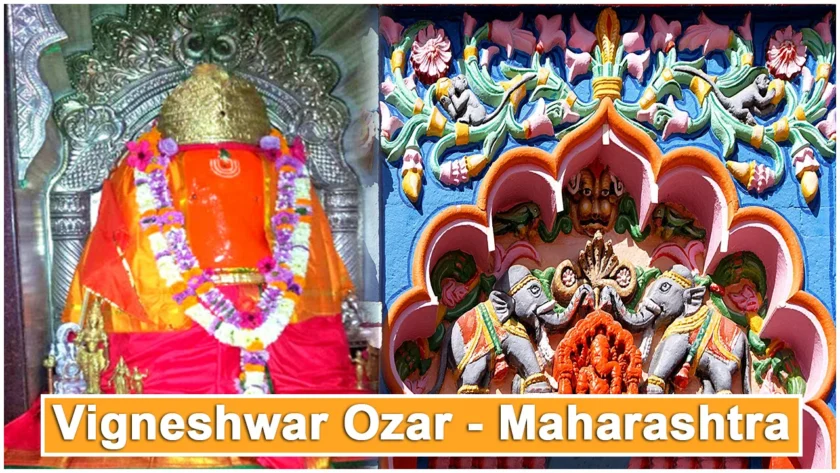
In popular parlance, Vighneshwar is the remover of obstacles, but the Sanskrit name is more layered: he is the Lord of obstacles, not merely their destroyer. He can create a strategic block when needed for the devotee’s ultimate good. At Ozar the Ganesha was invoked by King Abhijit the same king who coveted the Chintamani before his battle. Later, Indra himself worshipped here to defeat the asura Vritra.
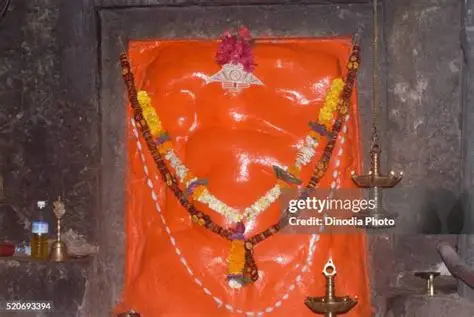
The murti here, flanked by brass icons of Riddhi and Siddhi, has a profoundly regal affect, with huge, unblinking silver eyes that follow you across the mandapa. The diamond-shaped tilak on the forehead is a rare urdhva-pundra variant, symbolising the ascent of kundalini through the sushumna. Ozar’s hidden gift is its capacity to teach the devotee discernment: the art of recognising that some closed doors are Vighneshwar’s protection, not his punishment. In a culture obsessed with removal of hurdles, this shrine insists that a well-placed obstacle is often the universe’s most sophisticated grace.
8. Shri Mahaganapati, Ranjangaon — The Cosmic Form of Power
District: Pune
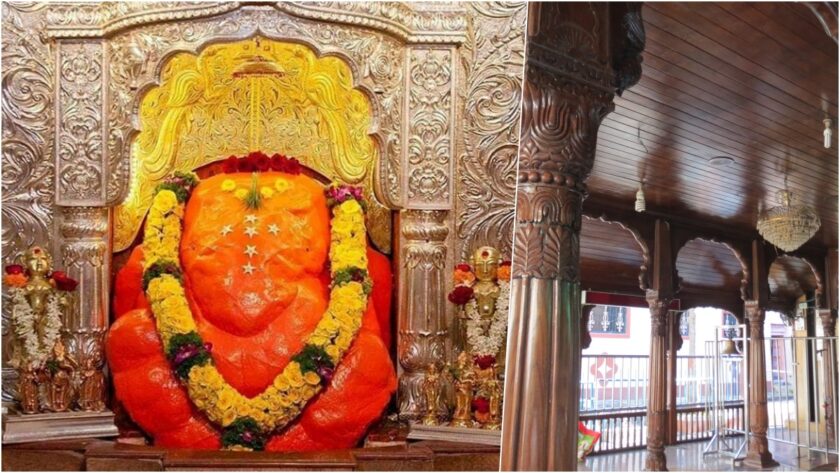
The circuit culminates at Ranjangaon, the seat of the Tantric sovereign. If Morgaon represents Ganesha as the sweet child, Ranjangaon is his Mahavishvarupa the form he assumed to destroy the demon Tripurasura by a mere glance. This is the only Ashta Vinayaka shrine where the murti is depicted with his consorts, Siddhi and Riddhi, seated on his left and right thighs respectively. The idol is gigantic, majestic, with ten arms holding weapons and emblems, the trunk deftly lifting a modak even amidst the display of cosmic weaponry.
Tripurasura, the demon of the three flying cities, could only be slain by a single arrow that would pierce all three simultaneously when they aligned in a line that occurred once every thousand years. The three cities represent the three bodies (gross, subtle, causal) or the three gunas (sattva, rajas, tamas). The single arrow is ekagrata—one-pointed concentration. Ganesha embodies that supreme focus that arises when the mind is utterly dissolved and only pure consciousness remains. Having journeyed through the other seven shrines—purifying the mind, gaining accomplishment, awakening devotion, receiving boons, extinguishing anxiety, realising the inner cave, and understanding the sacred function of obstacles—the pilgrim arrives here ready to glimpse the Mahaganapati, the all-encompassing unity. Ranjangaon is therefore not an end but an ignition point; here, the devotee is empowered to pierce the triple city of his own limiting identity.
F.A.Q.s:
1. What makes the Ashta Vinayaka so profoundly different from other Ganesha temples?
Unlike sculpted idols, these eight forms emerged from earth, cave, or riverbed, bearing nature’s own chisel-marks. Recognised by seers, they create a single, living yantra across Maharashtra. Each shrine is a distinct archetypal frequency designed to dismantle a specific inner obstacle—so the pilgrimage becomes not sightseeing, but a slow, embodied act of internal alchemy.
2. Is there a proper sequence for the pilgrimage?
The true sequence begins at Morgaon, the adi-pitha, and culminates at Ranjangaon. Doing it otherwise is like reading a novel backwards. You start with integrative calm (Mayureshwar) and progress through power, devotion, grace, healing, austerity, and obstacle-wisdom before meeting the cosmic Mahaganapati. It’s an energetic ascent, not a logistical loop.
3. What hidden detail at Pali’s Ballaleshwar do visitors miss?
The murti faces west—the direction of the setting sun, ancestors, and dissolution of worldly ties. This perfectly mirrors Ballal’s story of a devotion so potent it dissolved rigid paternal and karmic patterns. Even the offering changes to besan ladoo. The shrine quietly asks: which generational pattern are you finally ready to let the sun set upon?
4. What does Ranjangaon’s Mahaganapati finally give the pilgrim?
The capacity for ekagrata—one-pointed concentration. Tripurasura’s three flying cities are your three bodies; the single, perfectly timed arrow is a completely stilled mind. The prior seven shrines purify and prepare you, and Mahaganapati then becomes an ignition point, empowering you to shatter your own limiting identity long after you’ve left his presence.
5. In a single, honest sentence, what is the Ashta Vinayaka yatra really for?
It’s a masterclass in the architecture of awakening, disguised as eight temples—an external journey that patiently, inexorably becomes an internal dismantling of every obstacle the ego has built, until the pilgrim herself becomes the living, breathing centre of the mandala. That is the real yatra.
Conclusion:
Ashta Vinayaka is not a pilgrimage that we complete but one that completes us. The eight shrines are one stone-carved koan, and the pilgrim’s inner cities dissolve away, until there is only stillness. We don’t bring back a check list, we bring back a person in whom map and territory have become one.
